
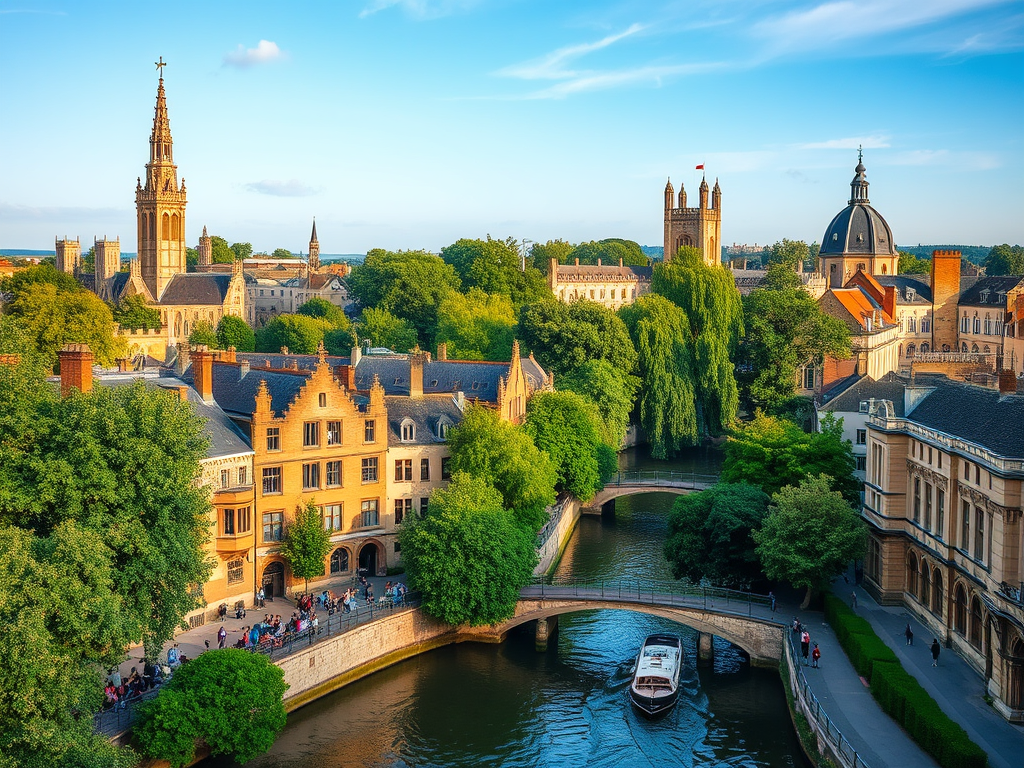
Great cities, according to Paul Graham, attract ambitious people. His essay “Cities and Ambition” fundamentally changed how I understood the invisible forces that shape our professional lives. It’s one of my most favorite articles that I read at different phases of life and took away newer meanings. Graham argues that great cities actively reshape what we consider worth pursuing. Each city sends a distinct message about what success looks like, and these messages are so pervasive that they seep into our consciousness through overheard conversations, glimpses through windows, and the energy of people walking past us on the street.
What makes Graham’s insight particularly profound is how he frames these environmental influences not as conscious choices, but as osmotic absorption. We don’t wake up one morning and decide to adopt a city’s values. Instead, the transformation happens through what he calls “accident” – the cumulative effect of thousands of micro-exposures to a particular worldview. A conversation overheard on the subway, the things visible through apartment windows at dusk, the topics that dominate dinner parties, the questions strangers ask when they meet you – all of these seemingly insignificant moments compound into a powerful force that reshapes our understanding of what matters.
The mechanism is both subtle and profound. Graham notes that while many people are strong enough to resist doing something just because it’s expected, far fewer can maintain motivation for work that no one around them cares about. This asymmetry between social encouragement and discouragement creates an invisible but powerful selection pressure. Over time, we don’t just adapt to our environment’s definition of success, we internalize it so completely that it becomes indistinguishable from our own authentic desires.
I didn’t fully grasp this concept until I mapped Graham’s framework onto my own journey across different countries and environments and eventually into the remote work revolution that followed. Looking back, I can see how each context rewired my definition of ambition, often without my conscious awareness. But more importantly, I began to understand how profoundly place shapes not just what we want to achieve, but how we think about achievement itself.
The process is remarkably similar to how we acquire language as children. We don’t consciously study the grammar of ambition in different places, we absorb it through immersion until it becomes second nature. Each environment has its own syntax of success, its own vocabulary of value, its own rhythm of recognition. And just as moving between linguistic cultures requires constant translation, moving between different ambitious environments requires a kind of psychological code-switching that most of us perform unconsciously.

The Morphology of Environmental Ambition
Graham’s insight becomes clearer when you consider how different environments shape not just professional identity, but the entire architecture of aspiration. Each context creates what we might call an “ambition ecosystem” – a complex web of social expectations, reward mechanisms, status symbols, and success narratives that collectively define what it means to thrive.
Some places cultivate an ambition toward understated excellence – environments where competence is expected to appear effortless, where the highest praise is delivered through subtle nods rather than applause. In these contexts, you learn that true mastery involves making complexity look simple, where the most impressive achievements are those that seem almost inevitable in retrospect. The ambition here is toward a kind of professional invisibility – becoming so skilled that your work appears to flow naturally from your character rather than from effort.
This creates a peculiar psychological dynamic. Success in such environments requires developing what might be called “effortless expertise” – the ability to perform at extremely high levels while maintaining the appearance of casual competence. It’s an ambition toward a kind of professional grace, where the mechanics of achievement remain hidden beneath a surface of apparent ease. The danger, of course, is that this can lead to imposter syndrome, where even highly accomplished people feel they’re somehow faking their way through challenges that should be more difficult.
Other environments pulse with velocity and transformation, creating what we might call “acceleration ambition.” These places don’t just reward speed – they reshape your fundamental relationship with time itself. In transformation-oriented environments, standing still is regression. The ambition becomes about evolutionary velocity: how quickly can you adapt, learn, pivot, reinvent yourself? Success is measured not by absolute position but by rate of change.
This type of environment creates a unique form of professional anxiety – not the fear of failure, but the fear of stagnation. The highest achievers in these contexts often describe feeling like they’re running up a down escalator, where maintaining position requires constant motion. But it also creates a distinctive form of professional confidence: the knowledge that you can reinvent yourself, that your identity is fluid rather than fixed, that adaptation is not just possible but inevitable.
Then there are environments that encourage what we might call “experimental ambition” – places where the highest value is placed on originality and boundary-pushing. These contexts cultivate ambition toward authentic creation rather than optimized performance. The question isn’t whether you can execute existing models excellently, but whether you can create entirely new categories of value.
This form of ambition is perhaps the most psychologically complex because it requires simultaneously embracing uncertainty while maintaining confidence in your vision. Experimental environments reward people who can operate without clear success metrics, who can persist through long periods of unclear progress, who can maintain conviction in ideas that others find difficult to understand or evaluate. The social dynamics are fascinating: respect is earned not through conventional achievements but through the courage to pursue unconventional paths.
Some environments emphasize systematic ambition – the drive toward optimization and procedural excellence. These places teach you that genius lies not in inspiration but in method, not in breakthrough moments but in consistent application of superior processes. The ambition here is toward becoming a kind of human algorithm, someone who can reliably produce excellent outcomes through systematic thinking and disciplined execution.
This creates a particular form of professional satisfaction: the deep pleasure of watching complex systems work smoothly, of seeing how good processes compound into extraordinary results. But it also requires a kind of ego sublimation, where personal creativity is channeled through institutional excellence. The most successful people in these environments often describe their work as “engineering serendipity”, creating conditions where good outcomes become inevitable.
And finally, there are environments focused on leverage and scale—contexts where the underlying ambition is toward maximum impact per unit of effort. These places teach you to think in terms of systems and networks, to consider how individual actions can create exponential effects. The ambition is toward becoming what we might call an “impact multiplier” – someone whose work affects far more people than direct contact would suggest.
This type of ambition is simultaneously inspiring and overwhelming. It’s inspiring because it suggests that individual effort can create massive positive change. It’s overwhelming because it makes most traditional measures of success feel inadequate. Once you’ve internalized scale-thinking, it becomes difficult to be satisfied with work that doesn’t have the potential for broad impact. This can lead to a kind of “impact inflation” where only world-changing projects feel worth pursuing.

The Remote Revolution: When Environmental Ambition Goes Virtual
But here’s where Graham’s framework encounters its most intellectually fascinating test: what happens when physical environment becomes optional? The pandemic fundamentally altered the relationship between place and ambition, creating what we might call the “unbundling of environmental influence.”
This shift has revealed something profound about the mechanism of ambition itself. Working remotely for the past few years has shown that what we thought was tied to geography was actually tied to community- and communities, it turns out, can be reconstituted in virtual space. Without the constant environmental pressure of a specific place, I’ve found myself consciously curating influences from different contexts and mindsets. The systematic thinking from efficiency-focused environments, experimental mindsets from creative contexts, velocity from transformation-oriented places, understated excellence from tradition-rich settings, and scale thinking from innovation hubs: they all became part of a more deliberately constructed toolkit.
This represents a fundamental shift from passive absorption to active curation. Instead of being shaped by wherever we happen to live, we can now consciously design our influence environment. We can join Slack communities that embody Silicon Valley’s scale thinking, participate in virtual book clubs that reflect Cambridge’s intellectual ambition, engage with online creative communities that channel artistic experimentation, or contribute to open-source projects that emphasize systematic excellence.
Remote work has created an entirely new category of ambition: the ambition to be location-independent while remaining intellectually and professionally connected to multiple centers of excellence simultaneously. Your physical location no longer determines your peer group, your definition of success, or your professional identity. Instead, you can consciously choose which voices to listen to, which communities to engage with, which definitions of success to pursue.
But this freedom comes with a profound psychological cost. The forced clarity that comes from living in a place with a strong, coherent message: whether focused on wealth, intelligence, creativity, or power – provided what we might call “ambition scaffolding.” Even if you disagreed with your environment’s definition of success, at least you knew what you were disagreeing with. The environmental pressure created a kind of useful resistance, a clear alternative to push against.
Without that scaffolding, it becomes remarkably easy to drift, to lose focus, to become unclear about what you’re optimizing for. The cognitive load of constantly choosing which influences to embrace and which to resist is exhausting. Many remote workers describe a kind of “ambition vertigo”: the disorienting feeling of having too many possible directions and no clear environmental pressure pushing them toward any particular one. When every type of ambition is equally accessible, the question becomes: which type of person do you want to become?
The Architecture of Distributed Ambition
Graham wrote his essay in 2008, when the idea that you could work from anywhere seemed like a distant possibility. Now, as we navigate a world where knowledge work has largely decoupled from geography, his insights feel both more and less relevant but in ways that reveal deeper truths about the nature of ambition itself.
More relevant because understanding the messages that different environments send has become a conscious choice rather than an unconscious absorption. If you’re working remotely, you can deliberately choose to spend time in communities (physical or virtual) that reinforce the kind of ambition you want to cultivate. This represents a kind of “meta-ambition” – the ambition to consciously design the influences that shape your other ambitions.
But this meta-ambition requires a sophisticated understanding of how environmental influence actually works. It’s not enough to simply join communities that align with your stated values. You need to understand the subtle mechanisms by which environments shape behavior: the questions that get asked repeatedly, the assumptions that go unquestioned, the stories that get told about what constitutes success, the rituals that reinforce group values.
Less relevant because the monopoly that specific places held over specific types of ambition has been broken. You can pursue intellectual ambition without living in academic centers, startup ambition without living in traditional tech hubs, or creative ambition without living in established cultural capitals. The geographic clustering that once seemed necessary for accessing particular types of ambition has been replaced by digital clustering: communities organized around shared interests and values rather than shared location.
This shift has profound implications for how we think about career development. The traditional model assumed that you would move to where the action was in your field: that advancement required geographic mobility. The new model suggests that you can bring the action to you by consciously curating your digital environment. But this requires a much more sophisticated understanding of what you’re trying to achieve and why.
Perhaps most importantly, remote work has revealed that the most powerful force shaping our ambition was never the physical environment, it was the social environment. The cities that Graham wrote about were powerful not because of their architecture or climate, but because of the concentration of people with particular mindsets and values. Once you understand this, you realize that the fundamental question isn’t “where should I live?” but “who should I surround myself with, and how can I do that most effectively?”
This insight has given rise to what we might call intentional influence design- the practice of consciously structuring your social and professional environment to reinforce the kind of person you want to become. This might involve joining online communities, attending virtual events, seeking out mentors and collaborators who embody particular values, or even something as simple as curating your social media feeds to reflect the conversations and concerns you want to engage with.
The question is “What do I expect of myself, and how can I create conditions that support that expectation?” This represents a fundamental shift from external validation to internal direction, from environmental adaptation to conscious internal design.